Foundation Settlement: Causes, Prevention, and Repair Methods | ultimate Guide
Introduction
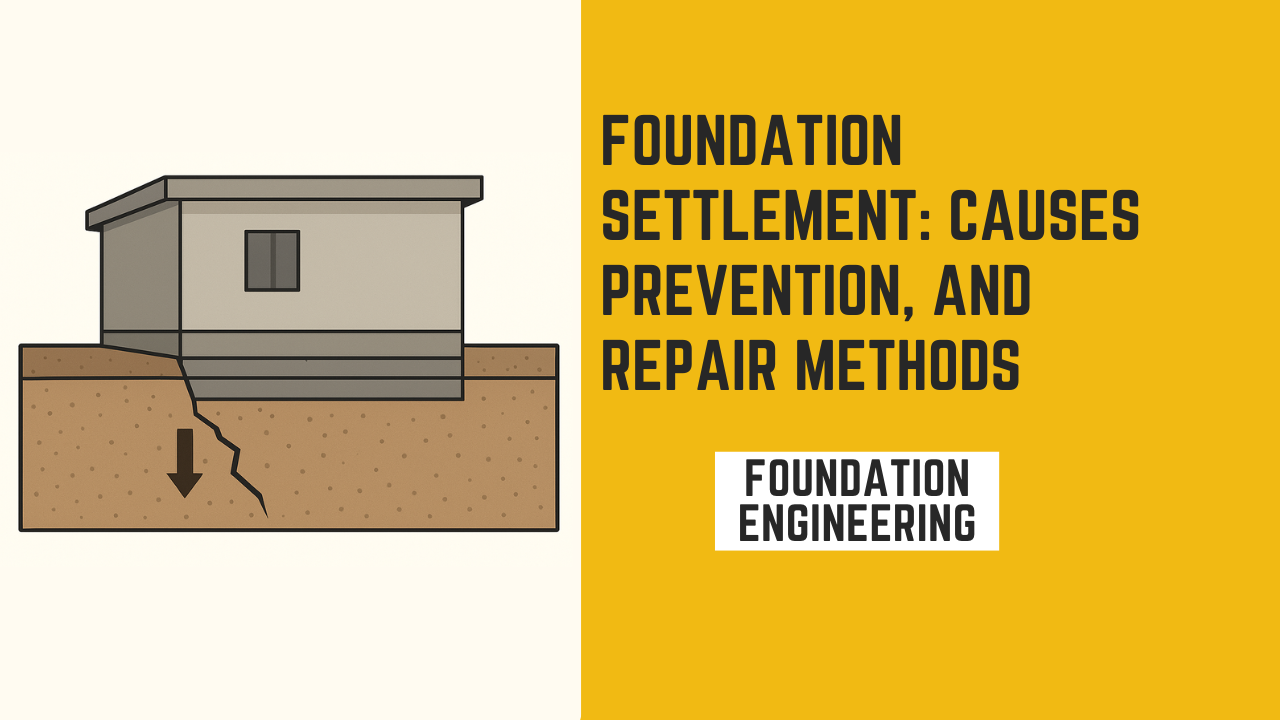
A strong and stable foundation is the backbone of every structure. However, even the most well-designed buildings can experience foundation settlement over time. Foundation settlement occurs when the soil beneath a structure compresses or shifts, causing the building to sink or move unevenly. This can lead to cracks, uneven floors, structural damage, and even partial collapse if not addressed properly
Understanding the causes, prevention techniques, and repair methods of foundation settlement is crucial for engineers, builders, and homeowners alike. This article explores everything you need to know about foundation settlement—from how it happens to how it can be prevented or repaired.
What is Foundation Settlement?
Foundation Settlement refers to the downward movement of a building’s foundation due to changes in the underlying soil or loading conditions. It typically occurs when the soil beneath the foundation can no longer support the structure’s weight
While some degree of settlement is normal , excessive or uneven settlement can compromise the integrity of the entire structure. Engineers classify settlement into two main types: uniform settlement and differential settlement.
Types of Foundation Settlement
1. Uniform Settlement
Uniform settlement occurs when the entire structure settles evenly. While it may cause minor changes in elevation, it usually doesn’t lead to serious damage because the structure moves uniformly
Example:
A building constructed on uniformly compressible soil may sink evenly as the soil compresses under the load.
2. Differential Settlement
Differential settlement happens when one part of the foundation settles more than another. This uneven movement leads to cracks in walls, distorted doors and windows, and structural stresses
Example:
If one corner of a building settles faster due to weak or wet soil, cracks may appear diagonally on the walls or foundation.
Common Signs of Foundation Settlement
Recognizing settlement symptoms early is crucial to prevent severe structural issues. Common warning signs include:
- Diagonal or stair-step cracks in brick or concrete walls
- Uneven floors or sloping slabs
- Gaps between walls and ceilings or floors
- Doors and windows that stick or won’t close properly
- Cracks in foundation walls or footings
- Tilting chimneys or columns
If these signs appear, an engineering inspection is essential to determine the extent and cause of settlement
Causes of Foundation Settlement
Foundation Settlement can occur due to a variety of geotechnical and structural factors. Below are the most common causes:
1. Poor Soil Bearing Capacity
The bearing capacity of soil determines how much load it can safely support. Soils with low bearing capacity—like clay, peat, or loose sand—compress more easily, leading to settlement.
2. Inadequate Compaction
When soil is not properly compacted before construction, it may compress over time under the building’s load. This is common in newly developed areas where fill material is used.
3. Changes in Moisture Content
Soil expands when it absorbs water and contracts when it dries. Repeated cycles of wetting and drying—especially in clay soils—can cause significant settlement.
Example:
Prolonged droughts may dry the soil, leading to shrinkage, while heavy rains may soften it, causing further compression.
4. Leakage and Poor Drainage
Water leaking from plumbing systems or poor site drainage can erode the soil beneath foundations. Over time, this leads to voids and uneven settlement.
5. Nearby Excavation
Excavations near an existing structure, such as for basements or tunnels, can reduce the lateral support of soil and cause foundation movement.
6. Heavy Structural Loads
Adding extra floors or heavy machinery increases the load on the foundation. If the original design didn’t account for these loads, settlement may occur.
7. Organic or Decomposable Soils
Soils containing organic matter (like peat or humus) decompose over time, reducing volume and causing settlement.
8. Vibrations from Traffic or Construction
Continuous vibrations from nearby traffic, trains, or heavy equipment can cause soil particles to rearrange and settle.
Effects of Foundation Settlement
The effects of foundation settlement vary from minor aesthetic damage to severe structural failures. Some of the common effects include:
- Cracks in walls, floors, and foundations
- Misalignment of structural elements (columns, beams)
- Structural instability and reduced load-carrying capacity
- Leakage through cracks, leading to dampness
- Decreased property value
- Potential collapse in severe cases
The severity depends on whether the settlement is uniform or differential, and how quickly it occurs.
Prevention of Foundation Settlement
Preventing foundation settlement begins with proper planning, soil analysis, and construction techniques. Here are the key preventive measures:
1. Site Investigation and Soil Testing
Before construction, conduct a detailed geotechnical investigation to understand soil properties such as bearing capacity, moisture content, and compressibility.
Tests like:
- Standard Penetration Test (SPT)
- Cone Penetration Test (CPT)
- Plate Load Test
- Moisture content and Atterberg limits
help engineers design appropriate foundation types.
2. Proper Soil Compaction
Ensure that the soil or backfill is compacted to the required density. Compaction reduces voids and prevents later compression under load.
3. Use of Suitable Foundation Type
Select the right foundation based on soil type and load:
- Shallow Foundations for strong soils
- Deep Foundations (piles or piers) for weak soils or heavy structures
4. Moisture Control and Drainage
Install effective drainage systems to prevent water accumulation near foundations. Maintain a consistent moisture level in expansive soils to avoid swelling and shrinkage.
5. Avoid Overloading
Do not exceed the design load of the foundation. Future load increments should be planned in the design phase.
6. Quality Construction Practices
Use proper curing, reinforcement, and concrete quality to avoid cracks and weak points in the foundation.
7. Landscaping and Site Grading
Ensure the ground slopes away from the foundation to direct water away from the building.
8. Regular Maintenance
Inspect foundations periodically for cracks, leaks, or drainage problems and repair them promptly to prevent long-term damage.
Repair Methods for Foundation Settlement
Once foundation settlement has occurred, several methods can be used to stabilize and restore the structure. The choice of repair depends on the cause, severity,and soil conditions. .
1. Underpinning
Underpinning is the process of strengthening and stabilizing an existing foundation by extending it deeper or spreading the load over a larger area
Types of Underpinning:
- Mass Concrete Underpinning: Traditional method where concrete is placed beneath the existing foundation in stages.
- Beam and Base Underpinning: A reinforced concrete beam transfers load to new concrete bases.
- Mini-Piled Underpinning: Small-diameter piles transfer loads to deeper, stronger soil layers.
Advantages:
- Suitable for heavy structures.
- Provides permanent stabilization.
2. Grouting (Pressure Grouting or Compaction Grouting)
This involves injecting a cementitious or chemical grout into the soil beneath the foundation to fill voids, strengthen soil, and lift the structure.
Applications:
- Used in sandy or loose soils.
- Suitable for correcting minor settlement.
Advantages:
- Minimally invasive.
- Rapid stabilization.
3. Soil Stabilization
Soil stabilization techniques improve soil properties by mixing stabilizing agents such as lime, cement, or fly ash.
Benefits:
- Increases soil bearing capacity.
- Reduces compressibility.
- Minimizes future settlement.
4. Pile Installation (Micropiles or Helical Piles)
Installing micropiles or helical piles beneath the existing foundation transfers the building load to deeper, more stable soil layers.
Advantages:
- Effective in weak or expansive soils.
- Can be installed with minimal vibration and disturbance.
- Suitable for both residential and industrial structures.
5. Slab Jacking (Mudjacking)
Slab jacking involves pumping a cement-sand slurry beneath a sunken concrete slab to lift it back to its original position.
Applications:
- Driveways, pavements, and floor slabs.
Advantages:
- Quick and cost-effective.
- Restores level surfaces without demolition.
6. Use of Geosynthetics
Geogrids, geotextiles, and geocells are used to reinforce the soil beneath foundations. They distribute loads evenly and prevent differential settlement.
7. Drainage Improvement
Installing French drains, sump pumps, and surface drains helps redirect water away from foundations, preventing erosion and soil softening.
8. Crack Repair and Sealing
For minor settlements, epoxy or polyurethane injections can be used to seal cracks and restore the integrity of concrete walls and foundations.
Foundation Settlement Case Study Example
- Case Study: Residential Building with Differential Settlement
- Location: Clayey soil area
- Symptoms: Cracks in walls and floor tiles, uneven doors
- Investigation Findings: Soil shrinkage due to seasonal moisture variations
- Solution:Mini-pile underpinning to deeper stable strata, improved drainage system installation.
- Result: Settlement stabilized, structure restored.
Thise case demonstrates how proper diagnosis and engineering intervention can restore stability and prevent further damage
Modern Technologies in Foundation Settlement Repair
Advancements in engineering have led to innovative solutions for settlement correction:
- Polyurethane Foam Injection: Expands on contact,lifting the foundation and filling voids.
- Laser Level Monitoring: used for real-time monitoring of settlement during and after repair.
- Geopolymer Injection: Environmentally friendly alternative to cement grouting
These technologies ensure minimal disturbance and faster completion compared to traditional methods.
Maintenance Tips to Prevent Future Settlement
1. Maintain consistent moisture levels around foundations.
2. Regularly clean gutters and drains to prevent water accumulation
3. Avoid planting large trees too close to buildings, their roots can displace soil.
4. Inspect for plumbing leaks and repair them promptly.
5. Schedule professional structural inspections every few years.
Proactive maintenance reduces the risk of long-term structural damage.
Conclusion
Foundation settlement is a natural process that can occur in any building due to changes in soil properties, moisture variations, or inadequate design. While minor settlement is often harmless, excessive or differential settlement can lead to significant structural damage if ignored.
The key to managing foundation settlement lies in early detection, proper soil investigation, quality construction, and timely repairs. Techniques such as underpinning, grouting, and soil stabilization can restore stability and prolong a building’s life.
By understanding the causes, prevention, and repair methods, engineers and homeowners can ensure that their structures remain safe, stable, and durable for decades.