
Slump Test of concrete: procedure, types, Importance, and applications
Introduction
Concrete is the backbone of modern construction, and its quality directly affects the strength, durability, and service life of structures. One of the most important properties of fresh concrete is workability, which determines how easily concrete can be mixed, transported, placed, compacted, and finished without segregation. Among various tests used to assess workability, the slump test is the most widely used due to its simplicity, speed, and cost-effectiveness.
The slump test of concrete is a standard field and laboratory test used globally to measure the consistency and workability of fresh concrete before placement. It helps engineers, site supervisors, and quality control personnel ensure that concrete meets design and construction requirements.
This article provides a detailed and practical explanation of the slump test, covering its definition, objectives, apparatus, procedure, types of slump, interpretation of results, factors affecting slump value, advantages, limitations, and real-world applications.
What is the slump test?
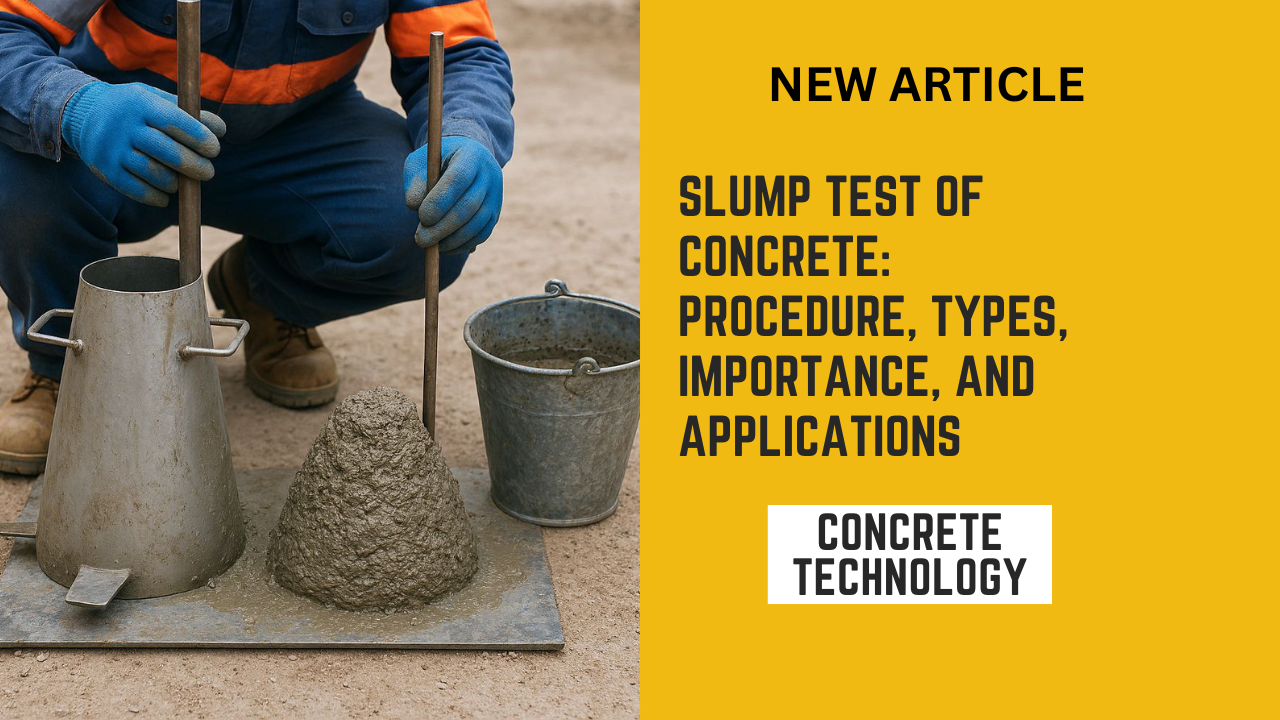
The slump test is a simple empirical test that measures the vertical settlement of freshly mixed concrete after removing a standard cone-shaped mold known as the slump cone. The amount of settlement, called slump value, indicates the workability or consistency of concrete.
The test does not directly measure strength but provides a quick indication of whether the concrete mix has the correct water content and consistency for proper placement.
Purpose of the Slump Test
The main objectives of performing a slump test are
- determine the workability of fresh concrete
- To check uniformity and consistency of concrete batches
- To control water-cement ratio at site
- To detect segregation or bleeding
- To ensure concrete suitability for specific construction work
- To maintain quality control during concreting operations
Importance of Slump Test in Construction
The slump test plays a critical role in construction projects for the following reasons:
- Ensures ease of placement and compaction
- Prevents honeycombing and voids
- Helps achieve proper surface finish
- Reduces chances of segregation
- Improves durability of concrete
- Avoids excessive water addition on site
Without proper slump control, concrete may become too stiff or too fluid, both of which can lead to structural and durability problems.
Apparatus Required for Slump Test
The slump test requires simple and standardized equipment:
1. Slump Cone (Abrams Cone)
- Height: 300 mm
- Bottom diameter: 200 mm
- Top diameter: 100 mm
- Made of metal, non-corrosive material
2. Tamping Rod
- Diameter: 16 mm
- Length: 600 mm
- Rounded ends
3. Base Plate
- Flat, rigid, and non-absorbent surface
4. Measuring Scale
- Used to measure slump value in millimeters
Standard Codes for Slump Test
The slump test is standardized under various international codes:
- IS 1199 – Indian Standard
- ASTM C143 – American Standard
- BS EN 12350-2 – British/European Standard
Slump Test Procedure (Step-by-Step)
The slump test must be carried out carefully to ensure accurate results.
step 1: Preparation of Equipment
- Clean the slump cone and base plate
- Place the cone on a flat, moist, non-absorbent surface
- Hold the cone firmly in position
Step 2: Filling the Cone
- Fill the cone with fresh concrete in four equal layers
Step 3: Compaction
- Compact each layer with 25 strokes of the tamping rod
- Rod strokes should be evenly distributed
- For upper layers, rod should penetrate into the layer below
Step 4: Leveling
- Strike off excess concrete to level the top surface
Step 5: Lifting the Cone
- Lift the cone vertically upward slowly and steadily
- Do not apply lateral or twisting motion
Step 6: Measurement
- Measure the vertical difference between the height of the cone and the highest point of the concrete
- This difference is the slump value
Types of Slump
Based on the shape of the concrete after removing the cone, slump is classified into three main types.
1. True Slump
In a true slump, concrete settles uniformly, maintaining its original shape.
Indication:
- Good cohesion
- Proper water content
- Suitable water content
True slump is the most desirable type and indicates workable concrete.
2. Shear Slump
- In shear slump, one half of the concrete slides sideways.
Indication:
- Lack of cohesion
- Poor aggregate grading
- Harsh mix
- Shear slump suggests the concrete mix needs adjustment and should be retested.
3. Collapse Slump
- In a collapse slump, concrete completely collapses and spreads.
Indication:
- Excessive water content
- Very high workability
- Risk of segregation
Collapse slump indicates an overly wet mix and is unsuitable for most structural works.
Recommended Slump Values for Different Works
Types of construction
Recommended Slump Values for Different Works
| Type of Construction | Recommended Slump |
| Mass concrete | 25–50 mm |
| Footings | 50–75 mm |
| Beams and slabs | 75–100 mm |
| Columns | 75–125 mm |
| Pumped concrete | 100–150 mm |
| Heavily reinforced sections | 100–180 mm |
Factors Affecting Slump Value
Several factors influence the slump of concrete:
1. Water Content
- Increased water increases slump
- Excess water reduces strength and durability
2. Cement Content
- Higher cement paste improves workability
3. Aggregate Size and Shape
- Rounded aggregates increase slump
- Angular aggregates reduce slump
4. Aggregate Grading
- Well-graded aggregates improve consistency
5. Admixtures
- Plasticizers increase slump without adding water
- Superplasticizers produce high-workability concrete
6. Temperature
- High temperatures reduces slump due to rapid evaporation
7. Time Delay
Slump decreases with time after mixing
Interpretation of Slump Test Results
Slump test results should be interpreted carefully:
- Low slump → stiff mix → difficult placement
- Medium slump → workable mix → normal construction
- High slump → flowing mix → risk of segregation
Slump alone should not be the only criterion for concrete quality; it must be correlated with mix design and placement conditions.
Advantages of Slump Test
- Simple and quick to perform
- Requires minimal equipment
- Economical and widely accepted
- Suitable for field conditions
- Provides immediate results
Limitations of Slump Test
- Despite its usefulness, the slump test has limitations:
- Not suitable for very dry or very wet concrete
- Does not measure strength directly
- Not reliable for high-performance concrete
- Subject to operator error
- Not suitable for very stiff mixes
Slump Test vs Other Workability Tests
| Test | Suitability |
| Slump Test | Medium workability |
| Compaction Factor Test | Low workability |
| Vee-Bee Test | Very stiff concrete |
| Flow Table Test | High workability |
Slump Test in Quality Control
On construction sites, the slump test is used to:
- Verify mix consistency
- Reject non-compliant concrete
- Monitor ready-mix concrete quality
- Maintain uniformity between batches
- It is often performed for every truckload of ready-mix concrete.
Common Mistakes During Slump Test
- Improper compaction
- Uneven lifting of cone
- Dirty equipment
- Incorrect layer thickness
- Delay in testing
These errors can lead to inaccurate slump values.
Safety Precautions During Slump Test
- Wear gloves and safety shoes
- Handle concrete carefully
- Clean equipment after use
- Avoid direct skin contact with cement
Practical Applications of Slump Test
- The slump test is used in:
- Residential buildings
- Commercial buildings
- Bridges and roads
- Industrial construction
- Ready-mix concrete plants
Conclusion
The slump test is one of the most essential and widely used tests in concrete technology. It provides a quick and reliable indication of the workability and consistency of fresh concrete, helping engineers and site personnel maintain quality and performance standards.
Although it has certain limitations, when used correctly and combined with proper mix design and quality control practices, the slump test plays a crucial role in producing durable, strong, and well-performing concrete structures. Every civil engineering professional must understand and correctly apply this test to ensure construction excellence.
Latest Articles
- Slump Test of concrete: procedure, types, Importance, and applications
- Raft foundation: Definition, types, design principles, advantages, and construction guide
- Types of Shallow Foundations in Construction | Ultimate Guide
- Steel Structure vs. Concrete Structure: Which Is Better?
- Steel structure: Design Principles, Advantages, Applications, and Future Trends in Modern Construction | ultimate Guide