Raft foundation: Definition, types, design principles, advantages, and construction guide
Introduction
In modern construction, selecting the right type of foundation is one of the most critical decisions affecting the safety, durability, and cost of a structure. Among various foundation systems, the raft foundation (also known as the mat foundation) has gained wide acceptance due to its ability to support heavy loads over weak soils while minimizing settlement issues. Raft foundations are commonly used in residential buildings, commercial complexes, industrial structures, and high-rise buildings where soil bearing capacity is low or loads are unevenly distributed.
This article provides a comprehensive guide to raft foundations, covering their definition, types, design principles, advantages, disadvantages, construction procedure, suitability, and practical applications. Whether you are a civil engineering student, site engineer, or construction professional, this guide will help you understand when and why raft foundations are used.
What is a raft foundation?
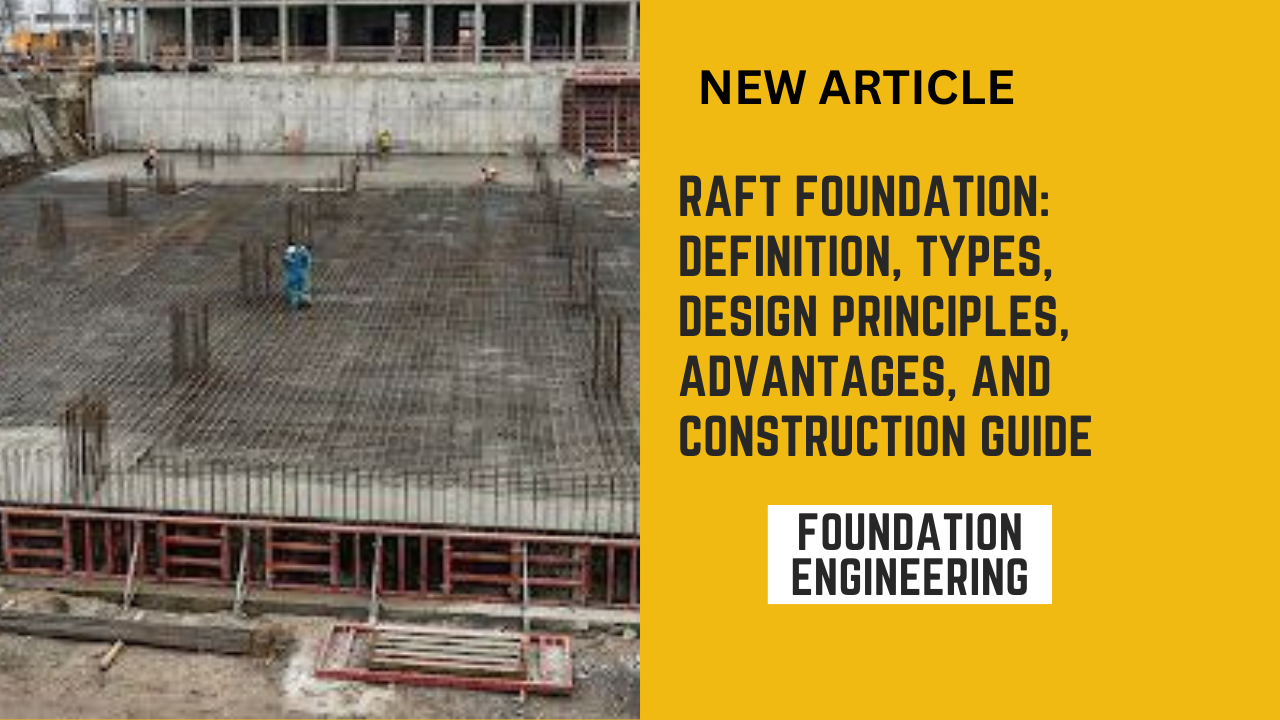
A raft foundation is a type of shallow foundation that consists of a thick reinforced concrete slab covering the entire footprint of a structure. This slab supports all columns and walls, spreading the load over a large area of soil. By distributing loads uniformly, raft foundations reduce excessive soil pressure and minimize differential settlement.
Unlike isolated footings or strip footings that support individual structural elements, a raft foundation acts as a single structural unit, making it especially suitable for poor soil conditions.
Why raft foundations is used
Raft foundations are preferred in situations where other shallow foundations are not suitable. Common reasons include:
- Low soil bearing capacity
- Heavy structural loads
- Closely spaced columns
- Unequal load distribution
- Presence of soft clay or loose sand
- Risk of differential settlement
In such cases, using isolated footings may lead to overlapping foundations or excessive settlement, making raft foundation a more economical and safer option.
Types of Raft Foundation
Raft foundations can be classified into several types based on structural configuration and load conditions.
1. Solid Slab Raft Foundation
This is the simplest form of raft foundation, consisting of a uniform thickness reinforced concrete slab supporting all structural loads. It is suitable for relatively light loads and small buildings.
Application:
- Residential buildings
- Low-rise commercial structures
2. Slab and Beam Raft Foundation
In this type, beams are integrated with the slab to increase stiffness and reduce bending moments. The beams run in both directions, forming a grid system.
Advantages:
- Improved load distribution
- Reduced slab thickness
- Better control of deflection
3. Cellular Raft Foundation
A cellular raft foundation includes hollow cells formed by top and bottom slabs connected by vertical walls. This type is highly rigid and suitable for heavy loads.
Application:
- Industrial structures
- Heavy machinery foundations
4. Piled Raft Foundation
This system combines a raft foundation with piles. The raft distributes loads, while piles provide additional support, especially where soil conditions vary significantly.
Advantages:
- Reduced settlement
- Increased load capacity
- Economical compared to full pile foundation
5. Raft with Pedestals
Pedestals are provided under columns to reduce punching shear and local stresses. This type is commonly used for buildings with heavy column loads.
Suitability of Raft Foundation
Raft foundations are suitable under the following conditions:
- Soil bearing capacity is low (less than 100 kN/m²)
- Columns are closely spaced
- Total load is high
- Differential settlement must be minimized
- Basement construction is required
- The water table is near ground level
Unsuitability of Raft Foundation
- Raft foundations may not be ideal when:
- Soil has very high bearing capacity
- The structure is lightweight
- The construction budget is very limited
- Deep foundations are structurally necessary
Design Principles of Raft Foundation
The design of a raft foundation involves both geotechnical and structural considerations.
1. Soil Investigation
A detailed geotechnical investigation is essential to determine:
- Safe bearing capacity
- Soil type and stratification
- Groundwater level
- Settlement characteristics
2. Load Calculation
All loads acting on the structure must be calculated accurately, including:
- Dead loads
- Live loads
- Wind loads
- Seismic loads
3. Bearing Pressure
The net soil pressure under the raft must be less than the allowable bearing capacity of the soil.
4. Settlement Analysis
Total and differential settlements should be within permissible limits to avoid structural damage.
5. Structural Design
- Structural design includes:
- Slab thickness calculation
- Bending moment analysis
- Shear and punching shear checks
- Reinforcement detailing
- Design is generally carried out as per relevant codes such as IS 456, BS 8110, or Eurocode 2.
Advantages of Raft Foundation
Raft foundation offers several advantages, making it a popular choice in modern construction.
- Uniform load distribution
- Reduced differential settlement
- Suitable for weak soils
- Cost-effective for large buildings
- Simplified construction compared to pile foundations
- Provides floor slab for basement construction
Disadvantages of Raft Foundation
- Despite its benefits, raft foundation has some limitations:
- High initial construction cost
- Requires skilled design and execution
- Not suitable for very deep, weak soils
- Construction quality control is critical
Construction Procedure of Raft Foundation
The construction of a raft foundation follows a systematic sequence to ensure quality and durability.
Step 1: Site Preparation and Excavation
Clear vegetation and debris
Excavate soil to the required depth
Ensure level and compacted base
Step 2: Anti-Termite and Waterproofing Treatment
Apply anti-termite treatment
Install waterproof membranes if required
Step 3: PCC (Plain Cement Concrete)
Lay a lean concrete layer to provide a clean working surface
Typical thickness: 75–100 mm
Step 4: Formwork Installation
Install shuttering for slab edges and beams
Ensure proper alignment and level
Step 5: Reinforcement Placement
Place bottom reinforcement as per drawings
Provide spacers and cover blocks
Fix top reinforcement and shear reinforcement
Step 6: Concreting
Use concrete of specified grade
Ensure proper vibration
- Avoid cold joints
Step 7: Curing
- Cure the concrete for at least 7–14 days
- Maintain moisture to prevent cracks
Raft Foundation vs Other Foundations
Raft Foundation vs Isolated Footing
| Aspect | Raft Foundation | Isolated Footing |
| Load distribution | Uniform | Concentrated |
| Soil suitability | Weak soils | Strong soils |
| Cost | Higher initially | Lower |
| Settlement control | Excellent | Limited |
Raft Foundation vs. Pile Foundation
| Aspect | Raft Foundation | Pile Foundation |
| Depth | Shallow | Deep |
| Construction complexity | Moderate | High |
| Cost | Economical for large area | Expensive |
| Soil condition | Soft soil | Very weak soil |
Common Failures in Raft Foundation
Common problems arise due to poor design or construction practices:
- Excessive settlement
- Cracking due to shrinkage
- Punching shear failure
- Improper reinforcement detailing
- Poor drainage and waterproofing
Applications of Raft Foundation
Raft foundations are widely used in:
- Residential buildings
- High-rise structures
- Commercial complexes
- Industrial plants
- Warehouses
- Basement and underground parking
Raft Foundation in Earthquake-Prone Areas
Raft foundations perform well under seismic conditions due to their ability to distribute loads evenly. When combined with seismic design principles, they enhance the overall stability of structures in earthquake-prone zones.
Cost Considerations
Although raft foundations may seem expensive initially, they often reduce overall construction cost by eliminating the need for multiple individual footings or deep foundations. Proper planning and optimization can significantly improve cost efficiency.
Conclusion
The raft foundation is one of the most reliable and widely used foundation systems in civil engineering, especially for buildings constructed on weak soils or carrying heavy loads. Its ability to distribute loads uniformly, reduce settlement, and improve structural stability makes it an excellent choice for modern construction projects.
With proper soil investigation, accurate design, and quality construction, raft foundations can provide long-lasting and economical solutions for a wide range of structures. Understanding its types, design principles, and construction methods is essential for every civil engineering professional.
Latest Posts
- Slump Test of concrete: procedure, types, Importance, and applications
- Raft foundation: Definition, types, design principles, advantages, and construction guide
- Types of Shallow Foundations in Construction | Ultimate Guide
- Steel Structure vs. Concrete Structure: Which Is Better?
- Steel structure: Design Principles, Advantages, Applications, and Future Trends in Modern Construction | ultimate Guide