Steel structure: Design Principles, Advantages, Applications, and Future Trends in Modern Construction | ultimate Guide
Introduction
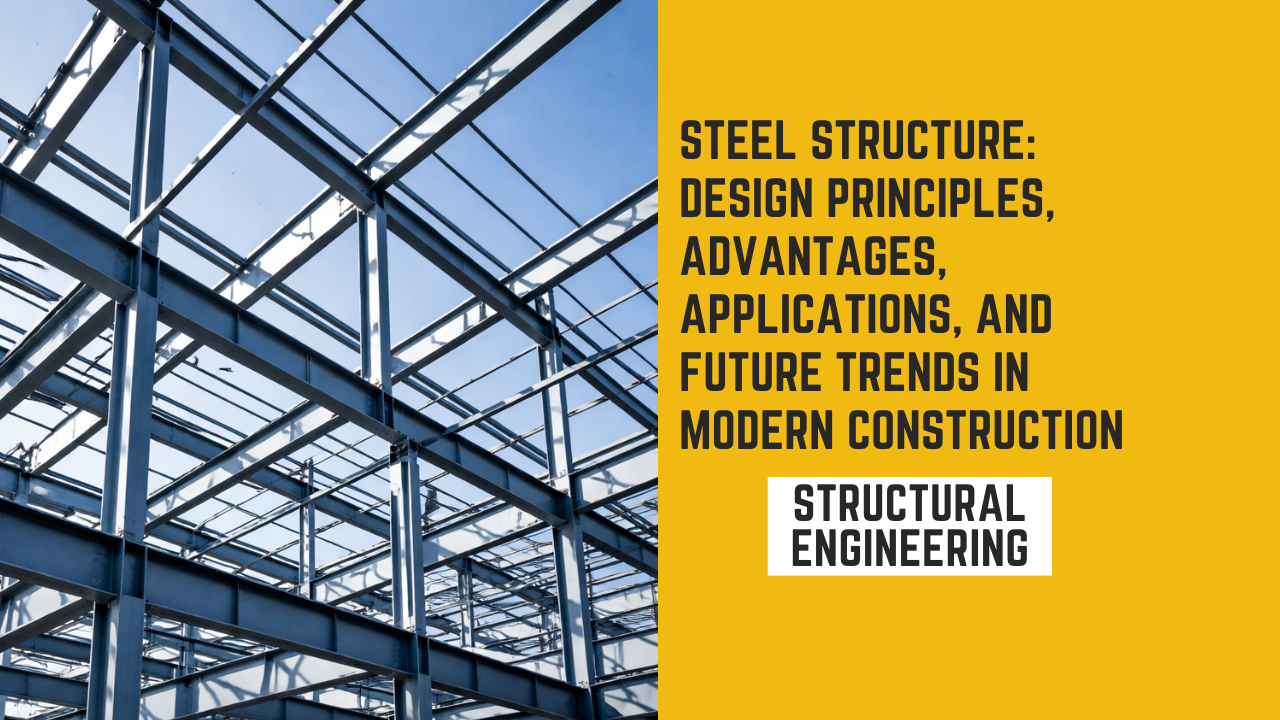
Steel structures play a vital role in modern construction, forming the backbone of skyscrapers, industrial plants, bridges, warehouses, airports, stadiums, and increasingly even residential buildings. With rapid urbanization, demand for faster construction, sustainable materials, and high-performance structures has pushed steel to the forefront of civil and structural engineering.
This in-depth blog article explains steel structures from fundamental concepts to real-world applications, covering design principles, types, advantages, limitations, construction methods, cost aspects, sustainability, and future trends.
1. Definition of Steel Structures
A steel structure is a construction system where steel members such as beams, columns, trusses, and plates are used to carry loads and resist forces. Steel structures are designed to safely transfer loads from the building to the foundation while maintaining strength, stability, and serviceability.
Steel is primarily an alloy of iron and carbon, with controlled amounts of other elements to improve strength, ductility, corrosion resistance, and weldability. Due to its predictable behavior and high strength-to-weight ratio, steel has become one of the most reliable construction materials worldwide.
Modern engineering standards allow steel structures to be designed with high precision using advanced software, resulting in safer, lighter, and more economical buildings.
2. History and Evolution of Steel Structures
The use of iron in construction dates back centuries, but steel structures gained popularity during the Industrial Revolution in the 19th century. The invention of the Bessemer process made steel affordable and mass-producible.
Key milestones include:
- Early iron bridges in the 18th century
- The first steel-framed skyscrapers in Chicago in the late 1800s
- Expansion of steel use in bridges, factories, and railways
- Adoption of high-strength steel and seismic-resistant design in the 20th century
Today, steel structures are designed using international standards such as Eurocode, AISC, BS 5950, and IS 800, supported by finite element analysis and Building Information Modeling (BIM).
3. Fundamental Components of Steel Structures
Steel structures consist of several interconnected components, each performing a specific structural function.
3.1 Columns
Columns are vertical members that transfer axial loads from beams and slabs to the foundation. Steel columns may be:
- I-sections
- Box sections
- Circular hollow sections
- Built-up sections
3.2 Beams
Beams resist bending caused by loads acting perpendicular to their axis. Common steel beams include:
- Universal beams
- I-beams
- Plate girders
3.3 Bracing Systems
Bracing improves lateral stability and resists wind and earthquake forces. Common types include
- Cross bracing
- K-bracing
- V-bracing
- Shear walls with steel frames
3.4 Connections
Connections are critical to structural integrity and include:
- Bolted connections
- Welded connections
- Riveted connections (older structures)
3.5 Trusses
Steel trusses consist of interconnected members forming triangular units, commonly used in roofs, bridges, and towers.
4. Types of Steel Structures
Steel structures can be classified based on function, fabrication, and structural form.
4.1 Framed Steel Structures
Used in buildings and industrial facilities, consisting of beams and columns connected rigidly or semi-rigidly.
4.2 Truss Structures
Common in long-span roofs, bridges, and transmission towers due to their material efficiency.
4.3 Space Frame Structures
Three-dimensional steel systems are used in airports, exhibition halls, and stadiums.
4.4 Pre-Engineered Steel Buildings (PEB)
Factory-fabricated steel structures designed for rapid construction, widely used in warehouses and factories.
4.5 Composite Steel Structures
Steel members are combined with concrete slabs to enhance strength and stiffness.
5. Design Principles of Steel Structures
Steel structure design follows three main criteria:
5.1 Strength
Ensuring members can resist applied loads without failure. Loads include:
- Dead loads
- Live loads
- Wind loads
- Seismic loads
- Snow loads
5.2 stability
Preventing buckling, overturning, and excessive sway.
5.3 serviceability
Limiting deflection, vibration, and cracking to acceptable levels.
Design methods commonly used are
- Allowable Stress Design (ASD)
- Load and Resistance Factor Design (LRFD)
- Limit State Design
6. advantages of Steel Structures
Steel structures offer numerous benefits, making them a preferred choice in modern construction.
6.1 high strength-to-weight ratio
Steel can carry heavy loads with relatively small cross-sections, reducing dead weight and foundation costs.
6.2 Speed of Construction
Prefabrication allows rapid assembly on-site, reducing project duration and labor costs.
6.3 design flexibility
Steel allows longer spans, column-free spaces, and architectural freedom.
6.4 Durability
With proper corrosion protection, steel structures have long service lives.
6.5 Seismic Performance
Steel’s ductility enables it to absorb earthquake energy without sudden failure.
6.6 Sustainability
Steel is 100% recyclable, reducing environmental impact.
7. Limitations of Steel Structures
Despite many advantages, steel structures also have challenges.
7.1 corrosion
Steel is susceptible to corrosion if not properly protected through painting, galvanization, or coatings.
7.2 Fire Resistance
Steel loses strength at high temperatures, requiring fireproofing measures.
7.3 Initial Cost
Steel structures may have higher initial costs compared to reinforced concrete in some regions.
7.4 Skilled Workforce Requirement
Fabrication and erection require skilled engineers and technicians.
8. Construction Process of Steel Structure
8.1 Design Detailing
Structural analysis and detailing are performed using software such as ETABS, STAAD Pro, and Tekla Structures.
8.2 Fabrication
Steel members are fabricated in factories, ensuring precision and quality control.
8.3 Transportation
Fabricated components are transported to the construction site.
8.4 Erection
Steel members are assembled using cranes, bolts, and welds.
8.5 Finishing and Protection
Fireproofing, painting, and corrosion protection are applied.
9. Applications of Steel Structures
Steel structures are used across various sectors.
9.1 High-Rise Buildings
Skyscrapers rely on steel frames for height and flexibility.
9.2 Industrial Structures
Factories, refineries, and power plants use steel due to heavy load requirements.
9.3 Bridges
Steel bridges offer long spans and high load capacity.
9.4 Warehouses and Sheds
Pre-engineered steel buildings dominate logistics and storage facilities.
9.5 Infrastructure Projects
Airports, metro stations, towers, and offshore platforms rely heavily on steel.
| Aspect | Steel Structures | Concrete Structures |
| Construction Speed | Faster | Slower |
| Weight | Lightweight | Heavy |
| Flexibility | High | Moderate |
| Maintenance | Moderate | Low |
| Seismic Performance | Excellent | Good |
11. Cost Considerations of Steel Structures
The cost of steel structures depends on:
- Steel grade and market price
- Fabrication complexity
- Transportation distance
- Fire and corrosion protection
- Labor and equipment
While initial costs may be higher, steel structures often provide lower life-cycle costs due to durability and reduced maintenance.
12. Sustainability and Environmental Impact
Steel structures support green construction through:
- Recyclability
- Reduced material waste
- Compatibility with modular construction
- Energy-efficient designs
Green building certifications often favor steel due to its sustainability credentials.
13. Codes and Standards for Steel Structures
Steel structures are designed using internationally recognized standards such as
- Eurocode 3
- AISC Steel Construction Manual
- BS 5950
- IS 800
- ASCE 7 for loading
Compliance ensures safety, reliability, and global acceptance.
14. Future Trends in Steel Structures
The future of steel structures is shaped by innovation and technology.
14.1 High-Strength Steel
Allows lighter and more efficient designs.
14.2 Modular and Prefabricated Construction
Reduces construction time and cost.
14.3 Bim integration
Improves coordination, clash detection, and project management.
14.4 Smart Steel Structures
Incorporating sensors for structural health monitoring.
14.5 Sustainable Steel Production
Reducing carbon emissions in steel manufacturing.
15. Conclusion
Steel structures are a cornerstone of modern civil engineering, offering unmatched strength, flexibility, speed, and sustainability. From skyscrapers to bridges and industrial plants, steel continues to redefine how structures are designed and built.
As technology advances and environmental concerns grow, steel structures will remain a preferred solution for safe, efficient, and future-ready construction projects. Understanding their design principles, advantages, and applications is essential for engineers, contractors, and developers aiming to build resilient and cost-effective structures.